


Financial sanctions and embargos have long been used by governments and international organizations as a means of applying economic pressure on rogue states in order to achieve political objectives. These measures aim to restrict or cut off the flow of financial resources to targeted countries or individuals, in order to limit their ability to pursue illicit activities or pursue policies that are considered detrimental to global security and stability. But are they effective?

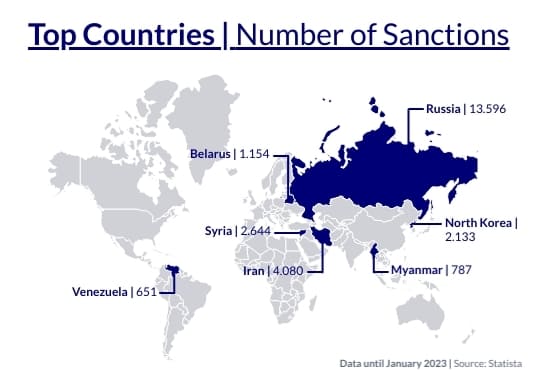
The number of financial sanctions programs has increased significantly in recent years. According the U.S. Treasury, the Office of Foreign Assets Control's (OFAC) sanctions have increased by 933% between 2000 and 2021.
The majority of these sanctions are targeted at countries in the Middle East and North Africa, followed by countries in Europe and the Americas. Sanction programs are imposed by a variety of actors, including national governments, international organizations, and regional bodies. The United States is one of the most active users of sanctions, with over 100 ongoing sanctions programs targeting a range of countries and individuals. Other major users of sanctions include the European Union, the United Nations, and the United Kingdom. These statistics suggest that financial sanctions are a widely used tool for achieving political, economic, and security goals. The increasing number of sanctions programs and the range of actors involved highlight the complexity and global nature of these measures.
What is the history of financial sanctions and embargos?
Financial sanctions and embargos have been used as a tool of foreign policy for centuries. In ancient times, embargos were often used to cut off trade with an enemy in order to starve them into submission. In the 5th century BC, the Athenians imposed a trade embargo on the city of Megara in order to punish it for siding with their enemies in the Peloponnesian War. Financial sanctions, on the other hand, have a more recent history. At the end of World War I, the League of Nations proposed the use of economic sanctions as a diplomatic expression to prevent future armed conflicts.
In the 20th century, the use of financial sanctions and embargos became more widespread, particularly after the Second World War when the United Nations was established. The UN has imposed a number of sanctions on countries in order to achieve various political objectives, such as preventing the spread of nuclear weapons, promoting human rights, and protecting the environment.

Financial sanctions and embargos have also been adopted by regional organizations such as the European Union and the African Union, as well as individual countries.
What are financial sanctions?
Financial sanctions are a type of economic measure that are designed to target the financial assets of individuals, organizations, or countries that are deemed to be a threat to the national security or foreign policy interests of the imposing country or organization. Financial sanctions are often imposed in response to activities such as terrorism, money laundering, proliferation of weapons of mass destruction, and human rights abuses.
What are the various forms of financial sanctions and embargos?
Financial sanctions and embargos can take a number of different forms, depending on the objectives and circumstances of the situation. Some common forms of financial sanctions and embargos include:
 |  |  |  |  |
|---|---|---|---|---|
Asset freezes | Trade restrictions | Financial transactions | Investment bans | Travel restrictions |
The use of financial sanctions and embargos can have significant effects on the target country or individual, restricting their access to resources and limiting their ability to conduct business.
What are the pros and cons of financial sanctions and embargos in foreign policy?
Financial sanctions and embargos can be a powerful tool in foreign policy, as they allow countries or international organizations to exert economic pressure on a target country or individual in order to achieve specific political objectives.

One of the main advantages of financial sanctions and embargos is that they can be targeted and tailored to specific situations. For example, trade restrictions can be focused on specific industries or sectors, and asset freezes can be applied to specific individuals or entities. This allows for a level of precision and flexibility that is not possible with other foreign policy tools, such as military intervention.
Another potential benefit of financial sanctions and embargos is that they can be relatively low-cost and low-risk compared to other forms of intervention. They do not require the deployment of military forces and can often be imposed without the need for direct confrontation. This can make them an attractive option for countries or organizations that want to exert influence without risking escalation or conflict. While financial sanctions and embargos can be a useful tool in foreign policy, they also come with significant challenges and drawbacks. As with any policy measure, it is important to carefully consider the potential costs and benefits before deciding to implement them. One of the most significant challenges is that they can have unintended consequences, such as harming innocent people or businesses. For example, trade restrictions can disrupt global supply chains and lead to higher prices for consumers, while asset freezes can prevent people from accessing their own money or assets.
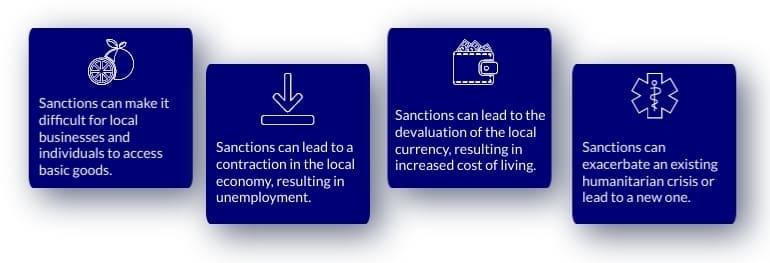
Another challenge is that financial sanctions and embargos can be difficult to enforce, particularly if the target country or individual is able to find ways to evade them. This can make it difficult to achieve the desired outcome and can even undermine the credibility of the sanctions or embargo.
Financial sanctions and embargos can be controversial and may be seen as a form of economic warfare, which can strain diplomatic relations and lead to escalation or conflict. Finally, these measures can be ineffective if they are not implemented in a coordinated and comprehensive manner, and if they do not have the support of key actors in the international community.

What are examples of successes and failures of financial sanctions?
Some examples of financial sanctions that have had a positive impact include the sanctions imposed on South Africa during the apartheid era, which helped to pressure the government to end its discriminatory policies, and the sanctions imposed on Iran, which have helped to curb its nuclear program. On the other hand, there have also been examples of financial sanctions that have had negative consequences.
For example, the sanctions imposed on Iraq in the 1990s were widely criticized for contributing to the humanitarian crisis in the country, and the sanctions imposed on Cuba have been criticized for harming the country's economy and its people. Overall, the effectiveness of financial sanctions depends on a variety of factors, including the target of the sanctions, the specific measures implemented, and the level of international support and cooperation.
Staying informed and compliant with financial sanctions and embargoes
There are several ways to keep up to date with financial sanctions and embargoes. One option is to follow news and updates from reputable sources, such as government websites, international organizations, and news outlets. These sources can provide information on the latest developments and changes to sanctions and embargoes. In addition, it is important to regularly check the list of designated individuals and entities that are subject to financial sanctions and embargoes, as these lists are often updated. Finally, consulting with legal advisors or experts in the field can be helpful in staying informed and compliant with these measures. The official websites of government agencies and international organizations that implement financial sanctions and embargoes are the best sources of information on the current list of active measures. In the United States, the Office of Foreign Assets Control (OFAC) within the Department of the Treasury is responsible for implementing and enforcing financial sanctions. OFAC maintains a list of designated individuals and entities that are subject to financial sanctions on its website, at https://www.treasury.gov/ofac. In addition, the United Nations also maintains a list of individuals and entities subject to sanctions on its website, at https://www.un.org/sc/suborg/en/sanctions/un-sc-consolidated-list. Other international organizations, such as the European Union and the Financial Action Task Force (FATF), also maintain lists of designated individuals and entities on their websites. It is important to check the relevant websites for the latest information and updates. Finally, consulting with legal advisors or experts in the field can be helpful in staying informed and compliant with these measures.
What improvements could be made to financial sanctions?
It is difficult to predict the future of sanctions or what improvements might be made to financial sanctions. However, there are a few potential developments that could potentially improve the effectiveness of financial sanctions.
One potential improvement is the use of more sophisticated targeting techniques. Current sanctions often rely on broad-based measures that are applied to entire countries or sectors, which can have unintended consequences and can be difficult to enforce. More targeted sanctions, such as those that target specific individuals or entities, may be more effective at achieving their intended goals without causing collateral damage.
Another potential improvement is the use of technology to monitor and enforce sanctions. For example, the use of blockchain technology or other digital tracking systems could make it easier to identify and prevent sanctioned individuals or entities from accessing the global financial system. Additionally, there may be opportunities for greater international cooperation and coordination on sanctions. Currently, different countries and international organizations often impose their own sanctions regimes, which can be difficult to manage and can lead to conflicting or overlapping measures. Improved coordination and cooperation could help to streamline the sanctions process and make it more effective.